
Industry 4.0 will not save Germany

Summary
Germany develops some of the world's most advanced manufacturing technology, but its own firms struggle to deploy it. This article asks why.
The standard narrative - energy cost, regulation, bureaucracy, talent shortages - explains pressure on Germany's industry but not why advanced tools fail to diffuse through it.
German manufacturers, especially in the Mittelstand (SME), lack the absorptive capacity to integrate architectural change into systems optimized for incremental innovation in stable product categories.
My diagnosis is supported by shop-floor experience inside SMEs, academic research, and macro signature of capital distribution.
Germany's industrial substrate remains strong - rank 6 globally, the highest engineering share of any OECD economy. Whether that substrate can be deployed before the absorption problem hollows it from within is the open question.
During my visit to the Hannover Fair 2026 a few weeks ago, I saw cutting-edge technologies, great solutions, and systems that showcase why Germany maintains its leadership position in global rankings of industrial complexity.
The Hannover Fair showcased the connected factory (smart factory), where machines communicate with each other, providing information and even generating orders or service requirements automatically through interconnected vendors. I've seen humanoids, digital twins, AI controllers, AI PLCs, AI MES/SCADA systems, AI this and AI that, and much more.
But it became evident that most of the showcased technologies would never achieve their full potential for German SMMs (Small and Medium Manufacturers) and SMEs (Small and Medium Enterprises).
I'm not satisfied with the usual narrative, like talent shortage, energy costs, regulation challenges, and so on. While I accept that these are challenges, I think they are oversimplifications of the multifaceted challenge that German SMMs and SMEs are facing.
So why won't these working tools translate into competitive growth in the firms buying them?
The answer is not that simple and requires us to create a comprehensive picture of Germany's industrial base. My goal is that at the end of this article, we will have the datapoints to create a structural answer to this question.
Move beyond the standard German manufacturing narrative
As mentioned in the introduction, I accept the standard narrative for Germany's industrial challenges, such as:
High energy prices
Too much regulation
Bureaucracy
Talent shortage
Aging workforce
Outsourcing
China competition
Weak digitalization
Slow permitting
Tax burden
Underinvestment
There are tons of articles that use these points to create the same old narrative that we've been reading for the past 20 years.
These factors explain why pressure is rising. They do not explain why Germany struggles to convert advanced tools into renewable industrial capabilities.
So we need to focus on deeper questions, like whether Germany has the industrial architecture, capital structure, supplier relationships, and learning environment required to absorb them.
My core argument is that German SMMs and SMEs lack the capacity to absorb technology because their internal architecture is focused on incremental innovation and the "old way of working" rather than on the reasons listed above.
Germany maintains its leading position in the Industrial Complexity Ranking
Economic development depends on how much productive know-how a country has and how effectively it uses that know-how to make a wide range of advanced products. As one of the most advanced industrial bases in the world, Germany holds a leading position in global complexity rankings.
The economic complexity index (ECI) is useful for understanding Germany's industry. Germany doesn't have a problem building complex technologies; its problem lies in using new technologies in its own production processes. The ECI does not measure one industry in isolation but captures the diversity and sophistication of Germany's productive capabilities. The chart shows Harvard's Growth Lab Atlas of complexity and compares countries based on the factors I described above.
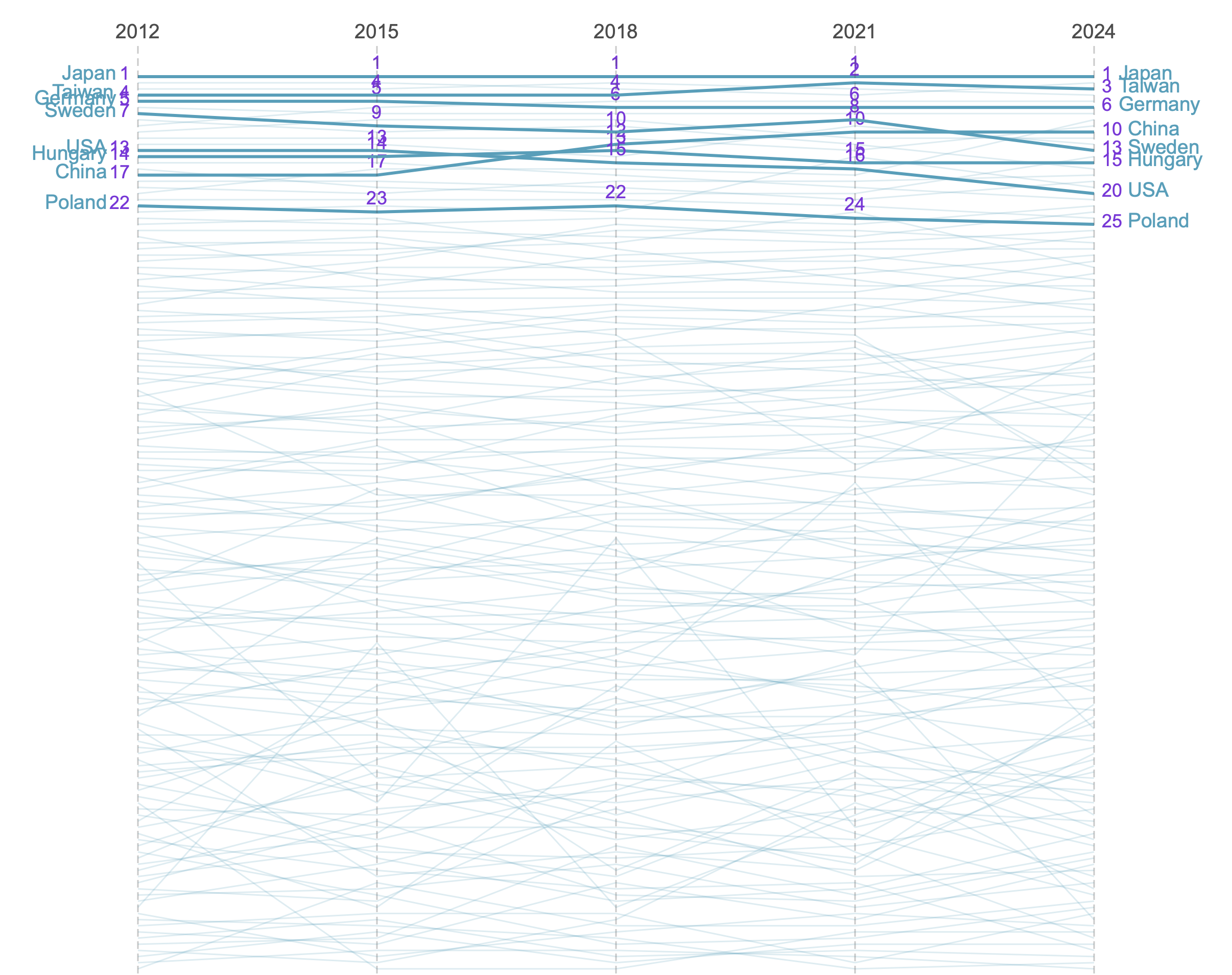
Germany remains one of the leading industrial countries, even though it dropped by one rank over the chart's timeline. I would not overinterpret this one-place movement. These rankings can change due to methodological shifts, changes in trade composition, and shifts in other countries' export structures. What we should take with us is that Germany is not a low-capability economy. It remains one of the most sophisticated industrial systems in the world.
This positioning aligns closely with Germany's focus on R&D expenditure as a % of GDP and in absolute terms.
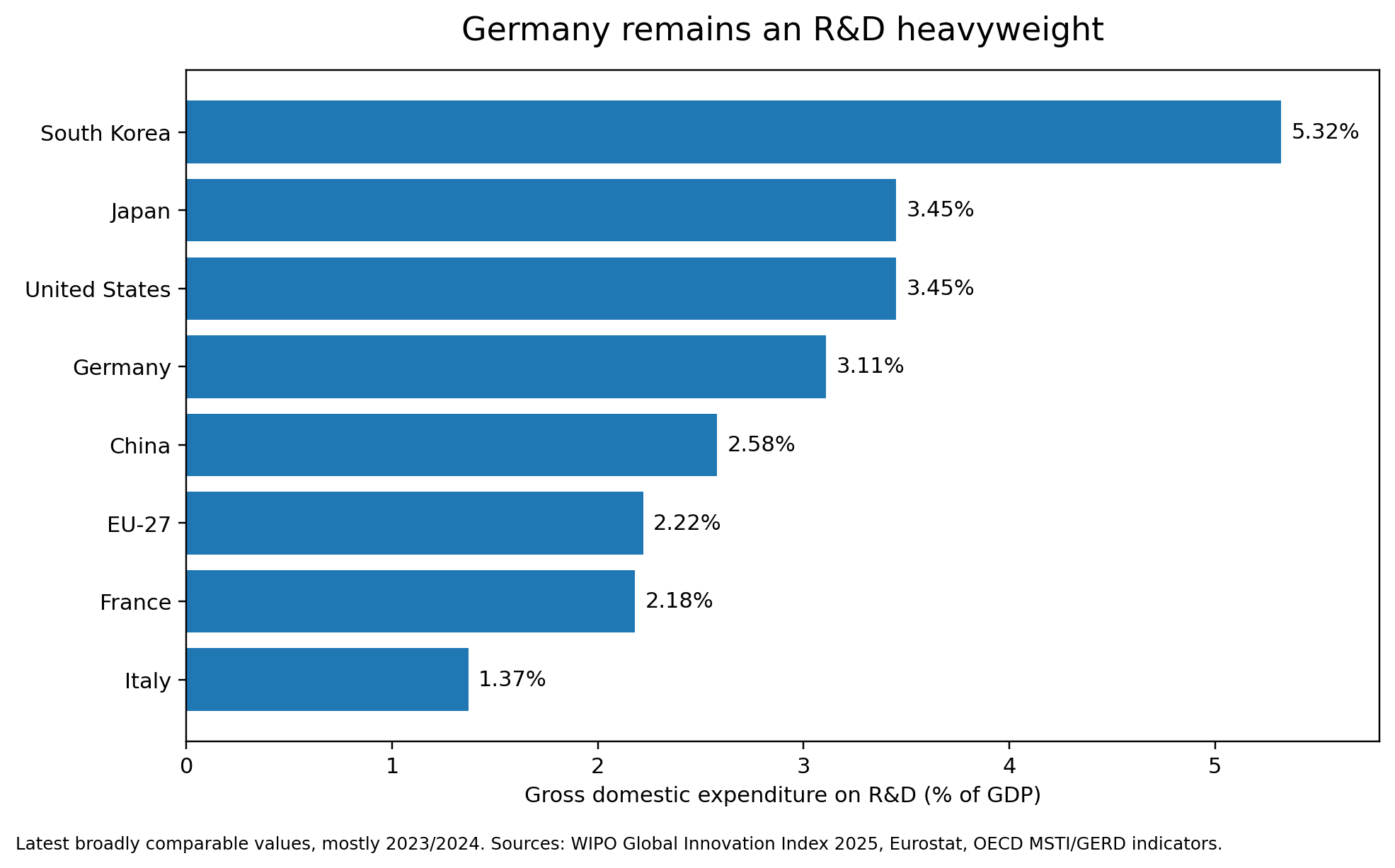
The chart above highlights Germany's engineering background and emphasis on research and development. This is also reflected in Germany's policies, which support collaboration between manufacturing industries and research institutes, serving as a prime global example. Germany created a set of institutions and policies that support cross-collaboration, as highlighted in a paper by the United Nations Industrial Development Organization.
This matters for the argument of this article. Germany's manufacturing problem is not that the country has already lost its industrial base or focus on the next generation of technologies. The problem is whether this highly complex manufacturing base can still renew its process capabilities fast enough. Germany lacks the technological absorptive capacity to adopt new manufacturing models.
What makes Germany stand out?
When reading about Germany's exports, we automatically think of the auto industry, but that misses the deeper structure. While cars make up a large part of Germany's export basket, it produces many of the components that other manufacturers in other countries need, such as machine tools, industrial equipment, automation systems, precision optics, specialty chemicals, and production technologies.
Examples include laser-cutting machines like Trumpf, lithography optics from Carl Zeiss (critical to ASML's EUV lithography machines), specialty polymers from BASF, and automation components from Bosch and Festo, just to name a few. These are products that other countries cannot easily replicate, and they make Germany the manufacturing base that other manufacturing bases depend on.
Japan has a similar capital-goods foundation to Germany but has a denser layer of robotics, semiconductor materials, and electronic components. Examples would be Shin-Etsu silicon wafers, FANUC robots, Murata passive components, things that, besides a few exceptions in Germany, like Infineon and Bosch, have never been built or built an extensive ecosystem around.
This comparison is important because it shows that Germany should not be analyzed as "just another car-exporting country." Germany sits upstream in the global manufacturing system. It produces parts of the productive infrastructure that other economies depend on.
If we look at Germany's export basketThe composition and focus on complex machinery, medications, and electronics become obvious.

European Industry, Semiconductors, Capital Allocation
Research on European and global industrial firms and the semiconductor supply chain.
How technology actually gets absorbed inside companies, the required strategy, and what that means for where capital earns a return.

I like to summarize the things that I read and that fit on no other platform on which I publish articles.
My website contains my thoughts and summaries regarding business-related topics.
If you have interesting articles or papers that you would like me to look into, feel free to reach out to me!
This site is published for informational purposes and is not investment advice, nor a recommendation to buy or sell any security. It does not take account of any individual's circumstances or objectives. Consult a licensed adviser before making investment decisions. I may hold positions in securities discussed; any such position is disclosed in the relevant article.