
Germany’s Productivity Gap
Germany got the machines but not the change
Summary
We begin with the definition of productivity related to real industrial factories. How does productivity translate for a company that produces real machines?
The factory as a system - it’s not enough to look at the machines inside the factory. A holistic view that includes office work must be developed.
The data layer across any manufacturing company must be taken into account to enable change that improves productivity.
I provide a methodology and framework for managers to assess their company’s productivity, identify constraints, find where the time goes, then decide on simplifying before digitizing, testing against the constraint, and finally test whether the company can execute the change, loosen the constraints selectively and productively, and make change continuous.
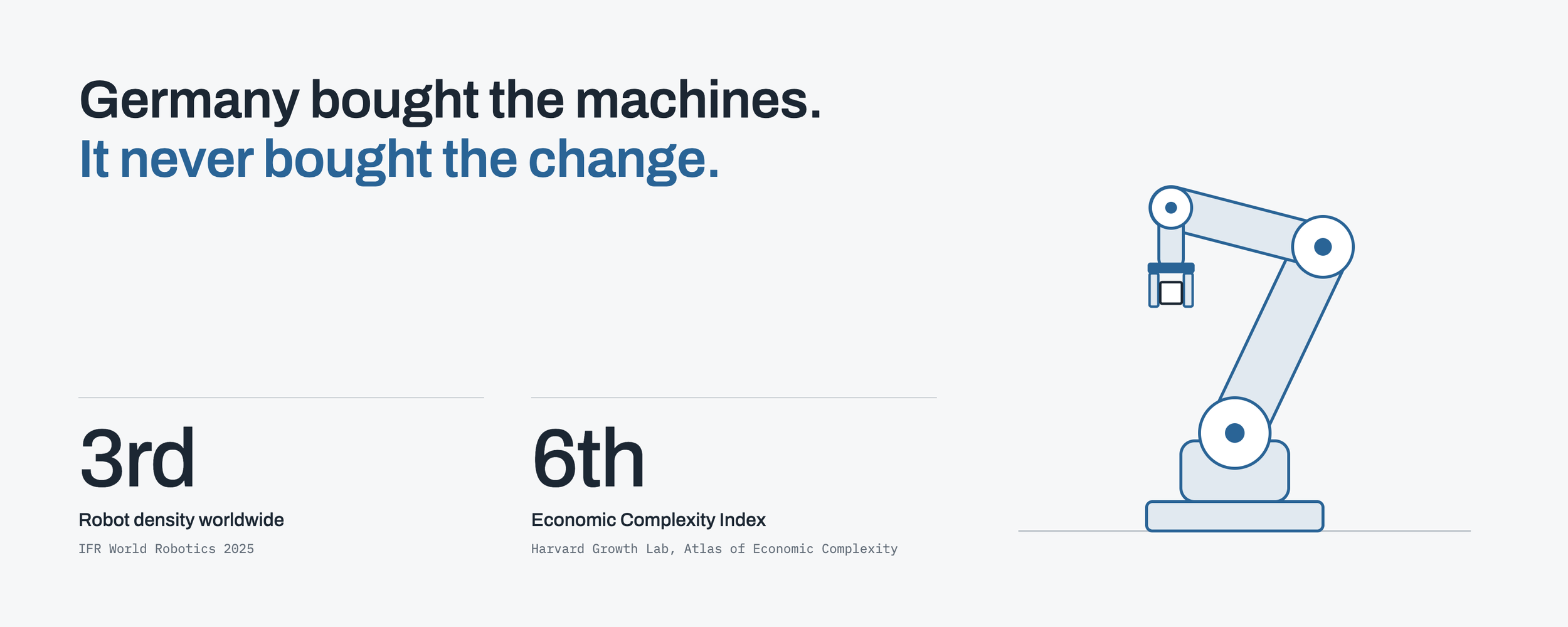
Germany produces the machines that raise other countries' productivity. It is the world's second-largest machine tool exporter, shipping many more machines than it consumes. German factories are among the most automated on earth, ranking 3rd by robot density, with 45 industrial robots per 1,000 manufacturing employees.
By every input measure, Germany is an economy that is equipped to build highly sophisticated goods - but - how can a country that manufactures productivity-enhancing machines, has enormous industrial R&D capabilities, and has one of the world's most automated manufacturing sectors experience almost no productivity growth?
In my previous article (Industry 4.0 will not save Germany), we discussed that Germany is among the world's most research-intensive economies and ranks near the top on the Economic Complexity Index.
Technological Waves
For 10 years, the framing was Digital Transformation, and for the last 5 years it has been AI. Both promised efficiency gains, but neither was visible in residual measures like Total Factor Productivity. The most prevalent explanations, like energy prices, weakening demand, or the automotive transition, describe shocks. The productivity problem predates them.
Let's look at the technological waves that changed the industries:
The first wave entailed automation. Germany excels because technology can be embedded in machinery.
The second wave involves digitalization. The benefits increasingly depend on organizational integration. Challenging change for German manufacturers.
The third wave is now AI, and its benefits depend even more heavily on changing workflows and organizational structures.
The problem isn't that German industry has difficulty adopting technology. The challenge is that technology's marginal productivity increasingly depends on the ability to reorganize around it.
Figure 1 shows Germany's productivity development and the factors driving it. Each bar is split into TFP (explained in the next chapter) and capital intensity (asset investments). In the 1990s until the financial crisis in 2008, Germany improved its productivity noticeably. However, throughout the last decade, Germany's productivity nearly flatlined.
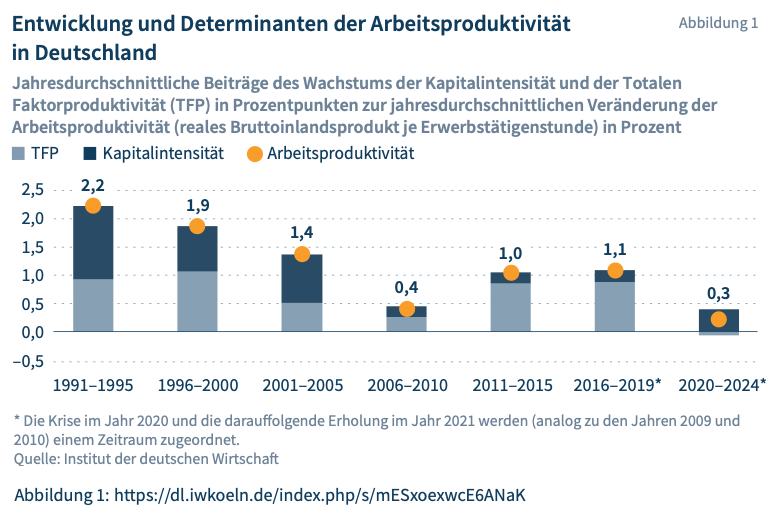
Figure 1: Contributions to German labour productivity growth. Kapitalintensität = capital intensity; Arbeitsproduktivität = labour productivity (Source: IW-Trends 2/2025)
A residual like the TFP is a leftover measure. It tells you that something is missing from the explanation, but not what. National accounts can show that German productivity growth has stopped; they cannot show why, because they average every firm and sector into a single number. Whatever is happening is happening somewhere specific, and the aggregate is the last place it becomes visible.
So, in this article we work downward through three levels of resolution - national accounts, sector, plant floor - which is close to how I would analyze a single company: the financial layer, the departmental architecture, and what is actually implemented on the working level.
The national accounts show the problem is real and sits in the residual rather than in investment. This lets us rule out specific topics: Germany has not stopped buying machines or doing research.
The sector shows what the constraint looks like when it binds. Automotive and machine building are where German industrial capability is concentrated, and they are where the architecture of the product is currently changing underneath. A sector is small enough to have a story and large enough to move the aggregate.
The plant floor is where the decisions are made. Someone chooses whether a new system replaces a process or wraps it. That choice is invisible in the statistics, gets made thousands of times a year, and determines everything above it.
The three levels are not three arguments but one argument across three magnifications. The claim is that the flat line in the first is produced by the choice in the third. This first part works through the national accounts and the plant floor. The sector level — where the constraint actually binds, in automotive and machine building — is the subject of Part 2.
Productivity
Let's start with national accounts and an explanation of productivity.
Productivity describes how efficiently a person, company, or whole industry turns inputs into outputs. There are two metrics economists use to determine productivity: Labor Productivity and Total Factor Productivity (TFP). However, most headlines collapse these two distinct measures into one, creating confusion for the audience.
Labor productivity is the real output per hour worked. It links wages and living standards. But labor productivity rises whenever you give a worker more capital - regardless of whether anything became smarter or more productive, or if you reduce the hours in the denominator. More capital means more expensive, better tools, like a new ERP or CRM system or a new factory machine. It can also mean allowing employees to use new AI models, with the capital converted into the tokens they burn. All of it raises output per hour.
These tools allow them to work more in the same or less amount of time. But the employee's work and processes don't necessarily change. Think about writing meeting minutes, reports, research tasks, blueprint generation, etc. You do the same but slightly faster.
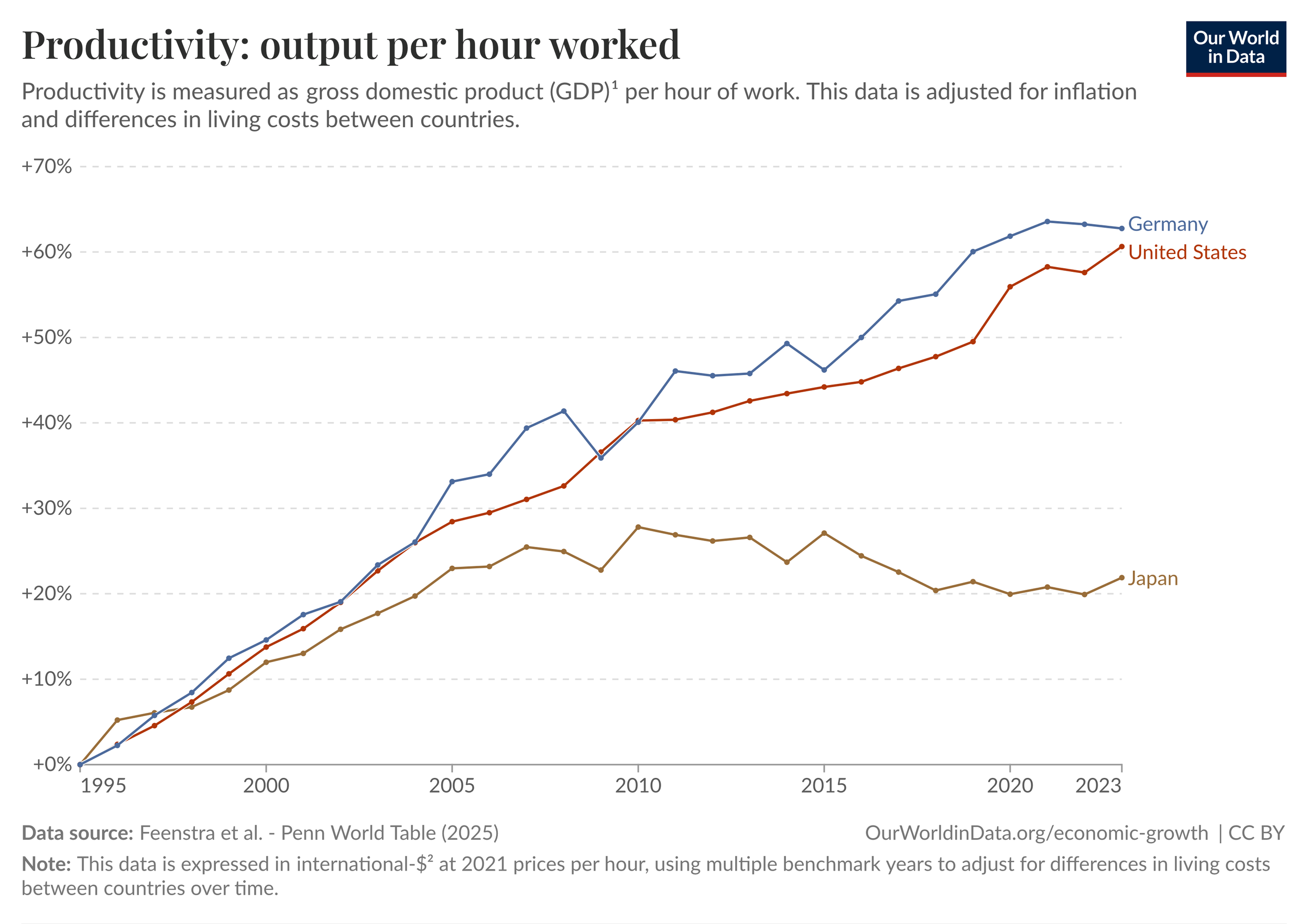
Figure 2: Productivity measured in Output per hour worked (Source: Our World in Data)
Total Factor Productivity (TFP) is the output growth left over after accounting for increases in both labor and capital - it's the part of output growth that more machines and more hours cannot explain. A higher TFP means that a company, industry, or country produces more with the same resources.
A TFP is not measured directly but through an assumed production function:
TFP growth = output growth − α×(capital growth) − (1−α)×(labour growth)
where α is capital's income share.
Worked example: output +3%, capital +4%, labour +1%, α = 0.35 → capital contributes 1.4%, labour 0.65%, TFP = the leftover 0.95%.
Abramowitz called it "a measure of our ignorance". TFP is not a measure of technology. It is a measure of everything not explained by measured capital and labour — technology, organisational capability, capacity utilisation, reallocation, market structure, and measurement error.
While the limit is clear, organizational capabilities and absorptive capacity is exactly those determinants that fall within the TFP. The measurement of this residual is consistent with what others authors determine to be the challenges within Germany, however, it also sets up a puzzle and doesn't explain it - which is the point of this article.
Labor Productivity growth = capital deepening + TFP growth
Baily, Bosworth and Doshi discussed productivity in their paper "Lessons from Productivity Comparisons of Germany, Japan, and the United States". They use both metrics described above, providing a holistic picture of productivity within the three economies. We will first look at the latest data from Our World in Data, then examine the paper's conclusion.
The labor productivity comparison (figure above) between the three economies from 1995 until 2023 (normalized to 1995) shows a generally rising trend, with Germany and the US rising in tandem, while Japan shows a sidelining and even declining trend.
To account for real productivity gains, we adjust the formula to intrinsically account for capital and labor inputs.
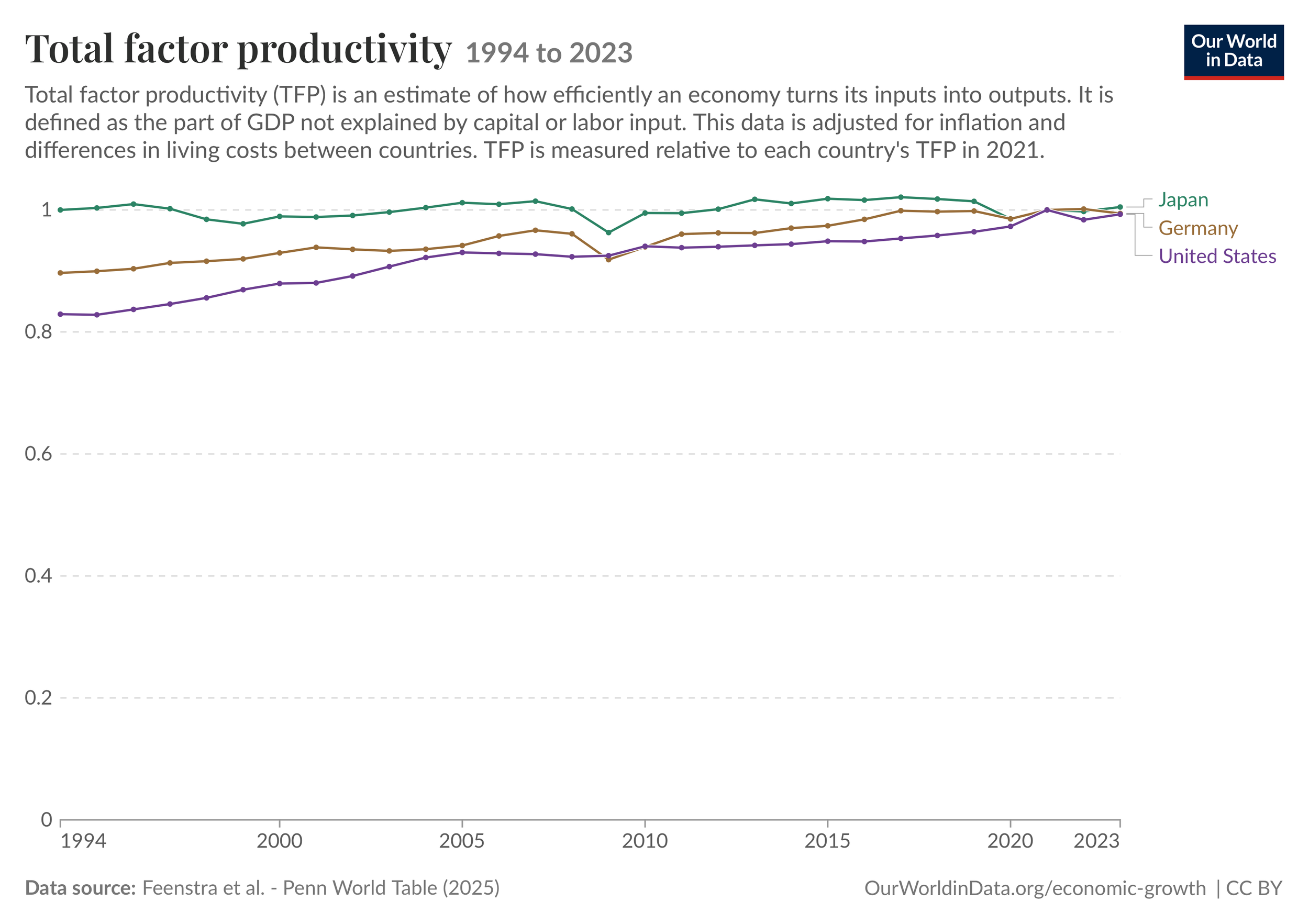
Figure 3: Total Factor Productivity (Source: Our World in Data)
The data is normalized to 2021 and shows that Japan didn't experience any productivity gains from 1995 to 2023, while Germany and the US experienced much smaller gains than the labor productivity chart indicated.
Baily's paper concludes that the German economy caught up to the US level of productivity in the 1990s and has since remained close behind. The US leads in IT and is home to some of the world's most innovative and well-known companies. But Germany has strong worker training and many fewer annual hours of work and more leisure than our US counterparts. The Japanese economy grew very strongly for many years, and its leading industries set new productivity frontiers (like Toyota or Sony in the 1990s). But that progress stalled in the 1990s and GDP per hour fell further behind to those in Germany and the US. Japan demonstrates that enormous industrial sophistication does not automatically produce continuing productivity growth.
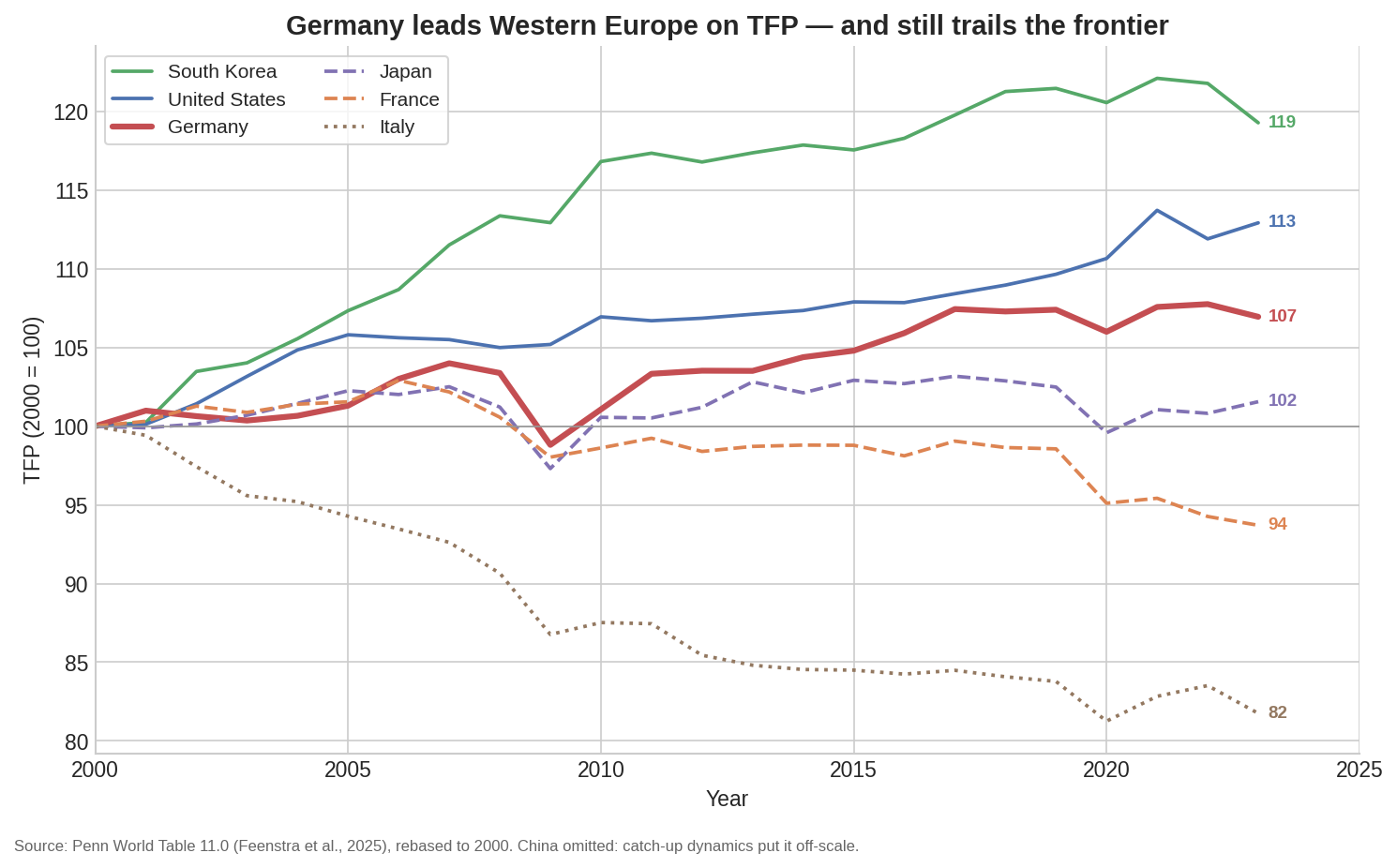
Figure 4: Peer comparison TFP (Source: Penn World Table)
Germany's position is easy to misread. Compared against its European peers rather than only against the US and Japan, Germany is not the problem case — it is the best-performing large economy in Western Europe on this measure, while France and Italy have gone backward since 2000. But it still trails the US and the fast-followers in Asia. That is the shape of the problem: not a declining economy, but a frontier economy that stopped moving while the frontier kept going.
Absorptive Capacity
In my experience, I argue that one of the least-discussed reasons for Germany's flatlining TFP growth is its industry's absorptive capacity.
But what is absorptive capacity?
A company's absorptive capacity is an intangible asset that results from the employees' prior knowledge, creating the ability to recognize the value of new information and, more importantly, to utilize it for commercial ends.
Cohen and Levinthal (1990) described absorptive capacity in their 1990 paper "Absorptive Capacity: A New Perspective on Learning and Innovation"
Prior related knowledge confers an ability to recognize the value of new information, assimilate it, and apply it to commercial ends. These abilities collectively constitute what we call a firm's "Absorptive Capacity"
Absorptive Capacity: A New Perspective on Learning and Innovation; [Cohen, Levinthal]
Other authors build on Levinthal and further conceptualize Absorptive Capacity. (Boynton, Zmud, & Jacobs (1994); Keller (1996); Kim (1998); Lyles & Schwenk (1992))
They conceptualize absorptive capacity across four dimensions: Acquisition, Assimilation, Transformation, Exploitation.
Acquisition - Understanding what new trends and tech is relevant for us.
Assimilation - Understanding the new tech and incorporating its learnings.
Transformation - Internalizing it to the company and its processes, figuring out the synergies and the necessary steps to use it.
Exploitation - Using and implementing new technologies and utilizing it as new competency. Adapting processes to fully exploit benefits.
To these, I'd add two: risk-taking and ownership of change that crosses organizational boundaries.
Cohen and Levinthal make an important point. Absorptive capacity is a byproduct of routine activity only when the new knowledge sits close to what the firm already knows. When a firm wants to acquire and use knowledge beyond its existing knowledge base, the firm must dedicate effort exclusively to creating absorptive capacity - it is not a byproduct.
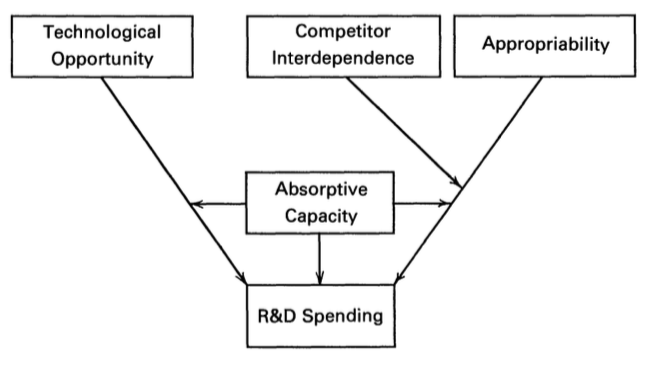
Figure 5: Model of Absorptive Capacity and R&D Incentives (Source: Cohen & Levinthal 1990)
Germany ranks sixth in the Economic Complexity Index and builds some of the world's most sophisticated machines. However, German machine tool innovation is embodied in exported capital goods, so the productivity improvements are exploited by the foreign buyers rather than the German producer. The resulting productivity gain shows up in a foreign firm's output, not in Germany's TFP.
This is the producer-versus-user split of embodied technical change.
That split holds, though, only as long as the builder cannot price its innovation fully into the machine. As Chinese competitors close the quality gap and undercut on price, more of that surplus passes to the buyer rather than remaining as German revenue. The trap tightens.
And the evidence shows that industries whose technical advances are bundled by equipment suppliers invest less in their own R&D. The absorption was already done by the machine-builder and sold as a product.
Absorptive Capacity - The German Experience
Let me explain what this means. Germany's industry has one of the highest operational robot densities per 1,000 employees worldwide.
Using robots in existing manufacturing processes required very little additional knowledge from companies, as they were installed within existing processes rather than requiring them to be redesigned. This is embodied, component-level absorption, and it is easy. Germany is world-class at it.
But real automation, what we call smart manufacturing within Industry 4.0 is not about new machines; it is about the disembodied layer. The software architecture, process design, and organizational methods. This disembodied layer doesn't arrive bundled with a machine, and a supplier can't sell these to you. They require absorptive capacity within the company, investment, and effort to acquire new knowledge to exploit the benefits.
Henderson & Clark described this dilemma in their paper: "Architectural Innovation: The Reconfiguration of Existing Product Technologies and the Failure of Established Firms." It describes why incumbents fail to absorb architectural change. I wrote about this in my article - "Architectural Innovation - Beyond the Innovator's Dilemma."
Interpreting Germany's industrial architecture through literature and experience, it's reasonable to conclude that Germany may be optimized for incremental complexity rather than for architectural change. Complexity becomes organizational inertia, enabling incremental improvements but, as currently depicted, making architectural change increasingly difficult.
Germany is beginning to lack Absorptive Capacity, and it shows up at every level we can measure.
Which brings the argument down to the plant floor.
When German firms are asked directly what holds back their productivity, the answers are consistent. Regulation and bureaucracy dominate, followed by a shortage of skilled workers, uncertainty and cost around decarbonization, shortage of R&D personnel, and then digitalization.
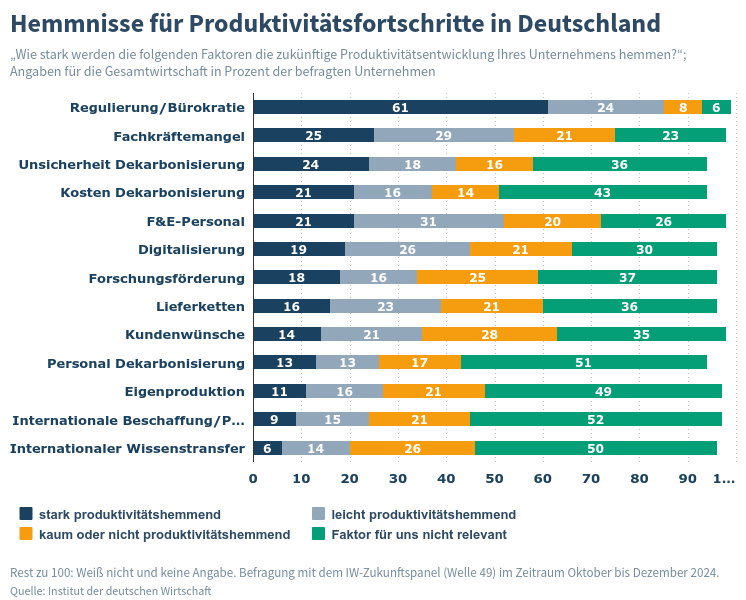
Figure 6: Inhibitor for Productivity Improvements in Germany (Source: IW-Trends 2/2025)
I do not want to argue with this. Bureaucracy is a real and heavy constraint in Germany, and anyone who has tried to modify a production site knows it. Permitting, documentation, and reporting consume more time than the change itself. Brownfield sites make it worse: retrofitting an existing plant carries a regulatory burden that often exceeds the engineering problem, which is one reason German manufacturers keep operating facility layouts designed for a different production logic.
But there is a problem with using a survey like this as a diagnosis, and it is worth examining. A survey of managers measures what they can perceive. It is a map of experienced friction, not one of causes.
From my experience, while change is wanted and highly valued at the executive level, and various teams work on it, it most often hits a bottleneck between the data interfaces and production. Investments start in the wrong place and ignore critical process bottlenecks that inhibit real integration and the benefit-wrapping of new tools and systems, leading to the same challenges with a new look.
Absorptive capacity is not something an organization can easily perceive in itself. It is intangible, it has no financial number backed behind it, and there is no moment at which it fails visibly. What a firm experiences instead is that projects take longer than planned, that a new system ends up running alongside the old one for too long, that the integration was harder than the vendor implied, and that there was never enough capacity. The underlying absorption and organizational challenges to reorganize are not on the list of available answers, because a firm that lacks it does not experience the lack as a distinct problem.
In my experience from the shop floor to management, my honest assessment is that the perception rarely gets past technology adoption. The question asked is whether we have introduced a new system. It is much harder to ask whether the organization has actually absorbed it, because absorption has no completion date and no invoice. It materializes in how people operate with systems. Assessing your own absorptive capacity requires a kind of self-knowledge that firms are not structured to produce.
Two things I would add to the survey from experience. The first is ownership across boundaries. A process change that stays inside one department has a manager who owns it, a budget line, and someone whose performance depends on it working. A change that crosses departments — production and IT, engineering and operations — often has none of these. Everyone involved is measured on something the change disrupts, and nobody is measured on whether it succeeds. This is not a shortage of people; it is a shortage of anyone whose job it is.
The second is risk tolerance around production. Changing a running process risks output, and the internal cost of a failed change is far higher than the internal cost of not attempting one (at least in the short term). Rationally, the individual choice is to wrap the old process rather than retire it, which is exactly the choice that produces a flat residual.
This is where the standard explanations fall short. "Energy prices" and "German wages are too high" are always true and have never been news. The sharper statement is that the German premium is stalling: German productivity growth is roughly zero, and in Figure 7 Germany's TFP growth has been stalling for nearly a decade.
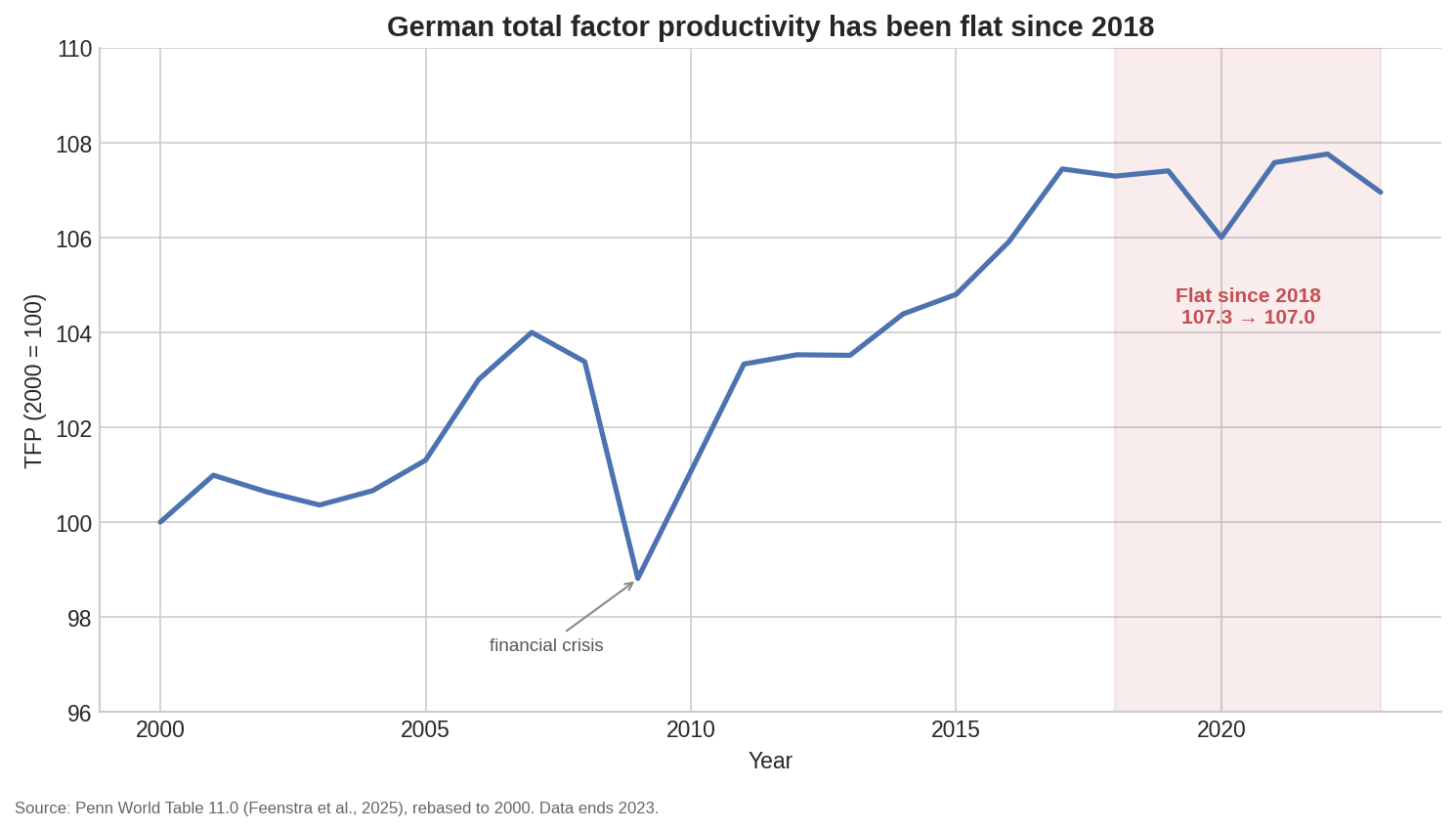
Figure 7: Germany's TFP normalized to year 2000 (Source: Penn World Table)
Germany has never competed on labor cost and never can. Its entire model rests on a productivity premium large enough to justify the wage premium. High wages are a competitiveness problem only when the productivity premium covering them stops growing.
Intangible Investments
There is a measurement problem sitting underneath all of this, and the World Intellectual Property Organization (WIPO) is trying to fix it. Their annual work with Luiss Business School estimates investment in intangible assets across 29 economies. Their central finding is that around 62% of intangible investment never appears in official statistics at all. Organizational capital, design, market research, and brands are not treated as investment in the national accounts. They are booked as current costs.
Think about it. The thing I described above as having no financial number behind it does not have one. Organizational capital like operating models, process design, platforms, supply chains, and distribution networks is the single largest category of intangible investment in the world, over 30% of the total, and it is almost entirely invisible in the GDP. An economy can systematically under- or overinvest in the capacity to reorganize, and the national accounts will not report it either way.
While I take these numbers with a grain of salt, they're revealing and align well with the arguments I'm making. The German composition is distinctive.
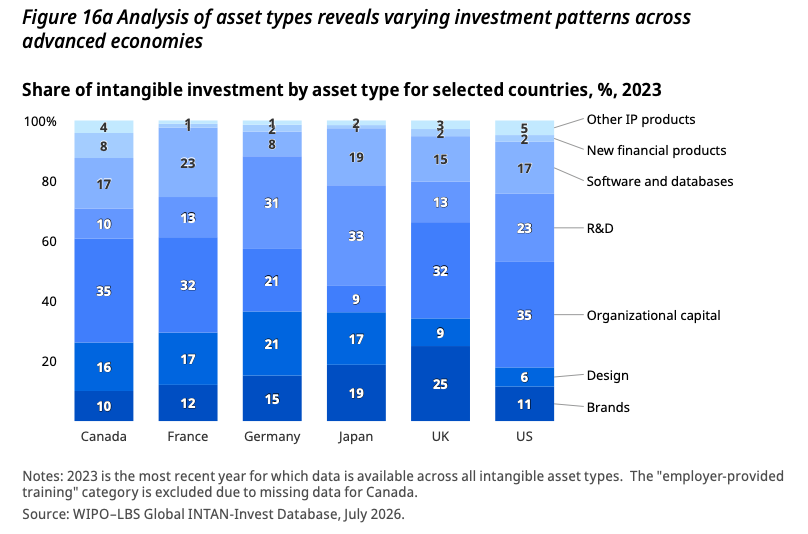
Figure 8: Share of intangible investment by asset type (Source: WIPO)
R&D accounts for 30.8% of German intangible investment, the second-highest share after Japan at 33.5%. Design accounts for 21.3%, which WIPO itself attributes to Germany's engineering-led industrial base. Organization capital sits at only 21%, the second-lowest, and Software and databases at only 8.2%, a smaller share than in all of the economies analyzed.
The pattern is a mirror image of what I experienced. Germany concentrates its intangible investment in R&D and design, the categories that deepen an existing engineering competence. The US, France, and the UK concentrate theirs in organizational capital and software, categories a firm buys when it changes how it works.
This is where the argument with Absorptive Capacity arises. Germany is a world-leading R&D country, but a patent is mostly knowledge an organization generated from inside its own competence. It is evidence of depth in what it already knows. Absorptive capacity is close to the opposite capability: the ability to take in knowledge from outside the organization's core competence and reorganize around it.
That is Cohen and Levinthal's argument, and most other researchers who have since written about absorptive capacity.
At the outcome level, Germany's own economists have measured the result. The IW's 2025 growth accounting finds that over the last five years, technical organizational change actually reduced German productivity growth, while the contribution of capital deepening has been weakening for some twenty years.
A fair objection is that if both capital deepening and TFP are weak, someone will say this is simply underinvestment - a capital story, not an absorption story. The answer is that the two are linked. Additional robots yield diminishing returns when the firm cannot perform the process redesign needed to exploit them, so firms rationally stop investing. Capital deepening fades because absorptive capacity is missing, not independently of it.
What This Adds Up To
Germany bought the machines. It never bought the change.
That pattern runs beneath every chart in this article. Robots arrive bundled - you install them into the process as it already runs, and the supplier has done the absorbing for you. Software architecture, process design and organizational methods do not arrive bundled, and no supplier can sell them to you. Germany leads the world in the first category and lags in the second. It is not a spending problem, which is why years of subsidy programs have not fixed it. It is an absorption problem.
This is also why the pattern repeats. Industry 4.0 promised transformation and delivered digitization, and now surveys see it as a productivity-inhibiting factor. AI is now arriving into exactly the same constraint, and the outcome is fairly predictable: a capability that requires no reorganization gets adopted quickly and yields little; a capability that requires reorganization would yield a great deal, and does not get adopted - it's much more difficult.
One limit on this argument, stated plainly. Absorptive capacity does not explain the whole Germany-US-China gap. The gap is not in absolute terms but in productivity growth terms. Most of that growth gap is a story about ICT (Information and Communication Technologies) and firm dynamism. Germany lacks a scaled technology sector and has a thin market for young high-growth firms. Absorptive capacity has nothing to say about companies that were never founded. What it explains is narrower and, for Germany, more consequential: the erosion of the industrial core that was supposed to be the strength.
Please do not view this as a doom-bringing article. I do not propose that Germany will erode, but that a whole layer of management and engineers need to rethink their approach to absorption, which is why I wrote this piece.
That erosion is where Part 2 picks up: what the constraint looks like when it binds, in the sector where German industrial capability is most concentrated — and what it means for anyone allocating capital to it.
Sources & Acknowledgments
Academic papers
Cohen, W. M. & Levinthal, D. A. (1990). Absorptive Capacity: A New Perspective on Learning and Innovation. Administrative Science Quarterly, 35(1), 128–152.
Henderson, R. M. & Clark, K. B. (1990). Architectural Innovation: The Reconfiguration of Existing Product Technologies and the Failure of Established Firms. Administrative Science Quarterly, 35(1), 9–30.
Zahra, S. A. & George, G. (2002). Absorptive Capacity: A Review, Reconceptualization, and Extension. Academy of Management Review, 27(2), 185–203.
Boynton, A. C., Zmud, R. W. & Jacobs, G. C. (1994); Keller, W. (1996); Kim, L. (1998); Lyles, M. A. & Schwenk, C. R. (1992)
Baily, M. N., Bosworth, B. & Doshi, S. Lessons from Productivity Comparisons of Germany, Japan, and the United States. Brookings Institution.
Corrado, C., Hulten, C. & Sichel, D. (2005, 2009). Measuring Capital and Technology: An Expanded Framework and Intangible Capital and U.S. Economic Growth, Review of Income and Wealth, 55(3), 661–685.
Brynjolfsson, E., Rock, D. & Syverson, C. (2021). The Productivity J-Curve: How Intangibles Complement General Purpose Technologies. American Economic Journal: Macroeconomics, 13(1).
Data sources and reports
WIPO & Luiss Business School (2026). World Intangible Investment Highlights 2026, July 2026 edition. Geneva: WIPO. DOI: 10.34667/tind.60182
Feenstra, R. C., Inklaar, R. & Timmer, M. P. — Penn World Table 11.0 (2025).
Our World in Data — processing and presentation of the Penn World Table series.
Institut der deutschen Wirtschaft (IW), IW-Trends 2/2025 — Bardt, H. & Grömling, M., Hemmnisse und Herausforderungen bei der Bewältigung der demografischen Produktivitätslücke in Deutschland.
International Federation of Robotics (IFR) — World Robotics 2025. Robot density.
Harvard Growth Lab — Atlas of Economic Complexity. ECI ranking.

European Industry, Semiconductors, Capital Allocation
Research on European and global industrial firms and the semiconductor supply chain.
How technology actually gets absorbed inside companies, the required strategy, and what that means for where capital earns a return.

I like to summarize the things that I read and that fit on no other platform on which I publish articles.
My website contains my thoughts and summaries regarding business-related topics.
If you have interesting articles or papers that you would like me to look into, feel free to reach out to me!
This site is published for informational purposes and is not investment advice, nor a recommendation to buy or sell any security. It does not take account of any individual's circumstances or objectives. Consult a licensed adviser before making investment decisions. I may hold positions in securities discussed; any such position is disclosed in the relevant article.